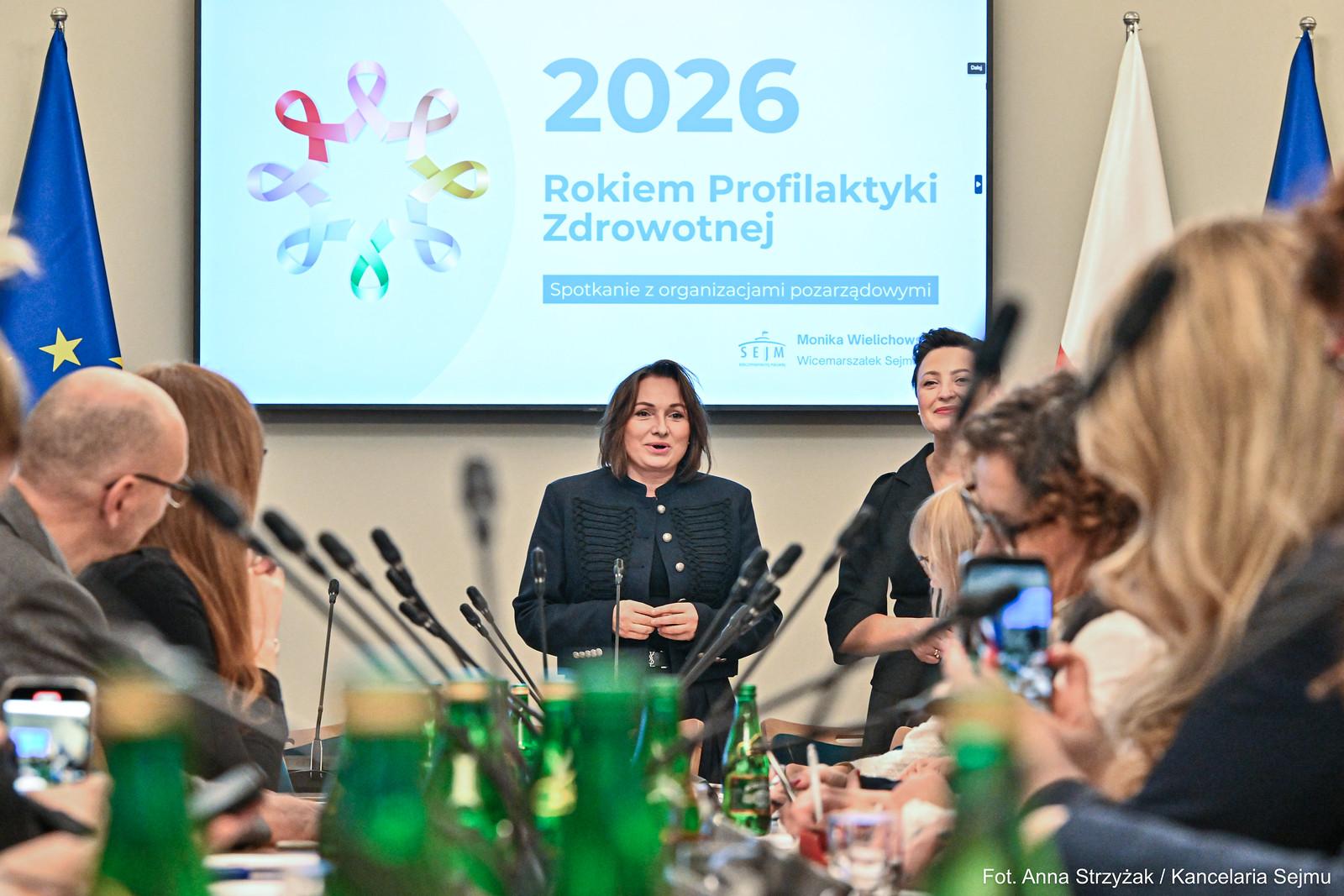
Since 2026 was declared the Year of Preventive Health Care, a meeting with nongovernmental organizations was held in the Sejm of the Republic of Poland under the patronage of Monika Wielichowska, Deputy Marshal of the Sejm.
During the meeting, Ewa Daros, President of the OliEdu Foundation, spoke, emphasizing the priorities for health initiatives in the areas of fertility and genetic testing for the coming year.
Fertility support can and should be understood as a form of preventive healthcare if viewed more broadly than merely as an assisted reproductive technology. Here’s how this procedure serves a preventive function:
- it protects against the loss of fertility,
- prevents genetic diseases,
- reduces the risk of pregnancy complications,
- minimizes the risk of infections,
- and protects mental and social well-being.
1. Prevention of Genetic Diseases
Thanks to advances in medically assisted reproduction techniques, it is possible—where medically justified—to prevent the transmission of severe genetic diseases to offspring. This is made possible by preimplantation genetic diagnosis of embryos (which requires the couple to undergo in vitro fertilization beforehand).
The resulting embryos can be screened for a specific severe disease that runs in the family or one for which both parents are healthy, asymptomatic carriers, but whose offspring, unfortunately, have a high probability of inheriting both abnormalities at once, which will result in very serious health consequences or even death.
Thanks to preimplantation genetic testing, only those embryos in which no serious mutations were detected are transferred to the mother’s uterus. This procedure prevents the development of severe and very often incurable diseases.
Preimplantation genetic testing allows for the detection of mutations responsible for monogenic diseases, (such as spinal muscular atrophy, cystic fibrosis, Duchenne muscular dystrophy, and others), which patients sometimes only learn about after years of ineffective treatment or after experiencing multiple pregnancy losses. Sometimes the problem for patients is the presence of a chromosomal translocation, which limits fertility but also creates a risk of pregnancy loss or the birth of a child with such severe abnormalities that, despite medical advances, the prognosis will be very poor, including the death of the child.
2. Prevention of Infertility
Assisted reproductive technologies allow for the freezing of eggs or sperm at a young age, which helps preserve fertility for the future. An example is Klinefelter syndrome (47, XXY) in boys, in whom progressive atrophy of the sperm-producing tissue means that by the time they decide to start a family, sperm can usually no longer be obtained, even using microsurgical techniques.
Reproductive prevention is particularly important for women whose egg count and quality decline drastically as a result of developing endometriosis, a disease that affects even teenagers and women in their 20s and 30s. Extensive surgical treatment also reduces ovarian reserve. Sometimes young women with no history of medical issues have very poor fertility parameters, and it is highly likely that when they decide to start a family, they will experience infertility—which may already be incurable at that stage.
Freezing gametes also serves as a safeguard against infertility caused by cancer treatment in young people of reproductive age—such as surgical treatment for testicular cancer in men.
Chemotherapy and radiation therapy for blood cancers, breast cancer, and other cancers also damage reproductive cells.
Oncofertility is based on taking proactive steps (before starting cancer treatment) to preserve fertility in people with cancer. This makes it possible to become pregnant after treatment is completed. Let’s remember that cancer is one of the most common diseases of modern society.
Often, such programs are the only chance for people who have undergone cancer treatment to have children.
3. Prevention of pregnancy complications
Thanks to PGT and embryo testing, the risk is reduced of:
- miscarriages caused by chromosomal aberrations (i.e., abnormalities in the number or structure of chromosomes) or genetic defects,
- losses of more advanced pregnancies, which are always associated with potential obstetric complications for the mother.
Where medically justified, in the presence of a known genetic risk factor, combining preimplantation genetic testing with in vitro fertilization (IVF) treatment allows for a healthier pregnancy and helps prevent many adverse events.
4. Infection prevention for couples in which one partner is infected with hepatitis B or C, or HIV
The use of medically assisted reproduction techniques and in vitro fertilization enables:
- the safe collection and preparation of cells,
- and the minimization of the risk of transmitting the virus to a partner or child.
As a result, the procedure serves as a preventive measure against infections in the field of reproductive health.
5. Prevention of the consequences of infertility
It is important to remember that infertility is a condition recognized by the WHO. If left untreated, it can lead to:
- depression,
- relationship problems,
- chronic stress and its health consequences.
Unfortunately, many illnesses that arise within a family often lead to its destabilization and a significant deterioration in the functioning of all its members, which has serious consequences for mental health.
As the OliEdu Foundation, we therefore call for democratic and equal access to preventive healthcare as an effective form of therapy that serves not only to protect family health but also mental and social well-being.
The information presented here has been verified by Dr. Katarzyna Olszak-Wąsik, an experienced gynecologist and geneticist who collaborates with the OliEdu Foundation.