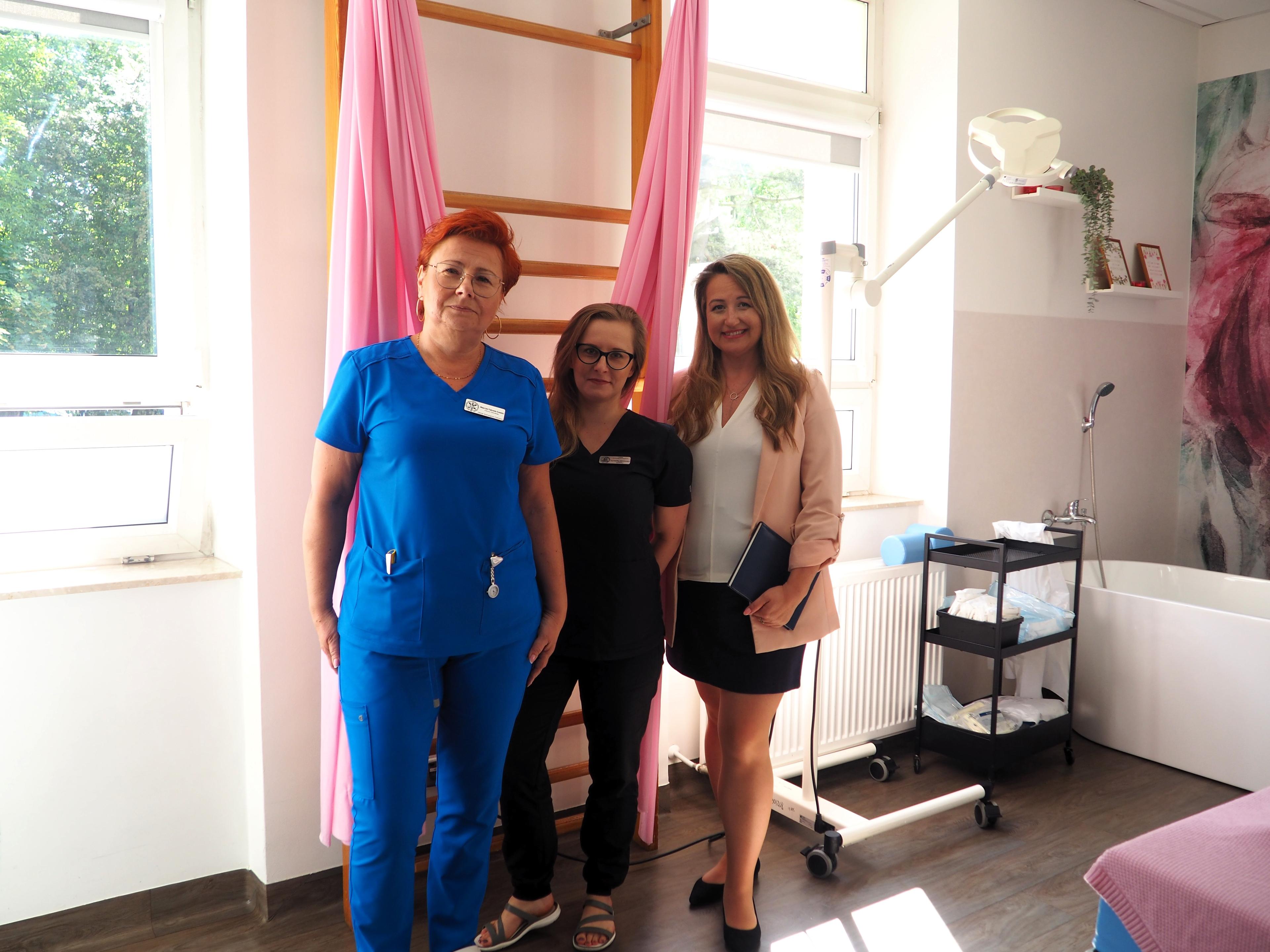
On Mother’s Day, we want to show how the World Health Organization (WHO) recommends building the mother-child bond from the very first seconds of a newborn’s life.
We’re talking about kangaroo care—direct skin-to-skin contact between the parent and the newborn immediately after birth. According to a conversation conducted by Ewa Daros, President of the OliEdu Foundation, with the team at the S. Żeromski Hospital in Kraków, kangaroo care between a mother and her newborn is recommended and possible when the birth occurs naturally and the baby is full-term —said Teresa Bujny, Chief Physician of the Neonatal Ward at the S. Żeromski Hospital. In such a situation, it is best for the mother to practice kangaroo care with her baby continuously for the first 2 hours of its life.
The mother of two-day-old Iga in the Neonatal Ward was also asked about the benefits of this practice; she described this time as the “golden two hours,” which nothing else can replace. Iga’s mother also added that this privilege is incomparable to a situation where a parent cannot practice kangaroo care immediately after birth—which, unfortunately, is exactly what she experienced after her previous delivery.
- When is kangaroo care not recommended?
One circumstance mentioned by Teresa Bujny is a cesarean section, when the baby is shown to the mother, who then has to remain in the operating room while her incision is sutured. During this time, fathers can take on the role of kangaroo-caring for their own baby, and Teresa Bujny acknowledged that this is happening more and more often. However, some fathers choose simply to hold the newborn, while others opt for skin-to-skin kangaroo care. Midwife Karolina Wójcikowska from the Gynecology and Obstetrics Department also noted that fathers’ awareness of this practice is growing.
The mother is usually available after about 20 minutes, once the surgery is complete.
Another circumstance that prevents kangaroo care immediately after the newborn’s birth is when the newborn experiences adaptation difficulties. The priority then is to examine the baby, and in the worst-case scenarios, to immediately save the baby’s life.
Difficulties also arise in the case of premature infants. As Teresa Bujny explained, it is difficult to practice kangaroo care when the baby needs to be stabilized. In such cases, parents can maintain contact, for example, by touching the infant’s hand.
- What are the benefits of kangaroo care, as listed by the team at the S. Żeromski Hospital in Kraków?
Among other things, it has a calming effect, as the baby hears the parent’s heartbeat. Kangaroo care calms the mother and provides a unique opportunity to get to know her baby. It also helps the father adjust to his new role. Kangaroo care often leads to the first feeding, because the baby intuitively seeks out the mother’s nipple and shows a desire to suckle.
It’s also about colonization with the parent’s bacteria, since the newborn’s body is then in direct contact with the mother’s or father’s bacteria, which helps boost immunity.
Midwife Karolina Wójcikowska from the Gynecology and - and Obstetrics Department at the S. Żeromski Hospital in Kraków added that an infant who is placed skin-to-skin with parents immediately after birth experiences less of a shock from the change in environment, which helps regulate breathing and improves heart function. Kangaroo care also has a positive effect on lactation and hormone secretion, not to mention the psychological benefits.
Karolina Wójcikowska also explained how helpful a kangaroo care chair is for parents, as it provides tremendous comfort.
- How often and for how long can and should parents practice kangaroo care with their newborns?
“As much as they want and whenever they want,” replied Teresa Bujny, adding that grandparents or other close relatives can also practice kangaroo care with the baby.
Małgorzata Piątkowska-Kowalska, head of the Gynecology and Obstetrics Ward, noted that kangaroo care gives strength. She always encourages patients in her ward who are initially afraid or have concerns to try it, explaining that it brings mutual joy and pleasure. Małgorzata Piątkowska–Kowalska also emphasized how important it is for parents to cuddle their child throughout their entire life!
Interview conducted by:
Ewa Daros, President of the OliEdu Foundation